

If you've ever felt like you were finally moving forward, only to wake up one day feeling like you're back at square one, you are not broken. You're healing. The expectation that healing should feel like a steady climb is one of the most damaging myths in recovery. Understanding why healing is not linear isn't just comforting. It's the key to releasing shame and staying the course when the road gets hard. This article walks you through the science, the emotional truth, and the practical wisdom that makes sense of your non-linear healing journey.
Table of Contents
- Key takeaways
- Why healing is not linear: the science behind it
- Healing trauma: layers, emotions, and integration
- Common myths about healing that keep you stuck
- Practical ways to support your non-linear healing path
- My honest take on the non-linear healing path
- You don't have to walk this path alone
- FAQ
Key takeaways
| Point | Details |
|---|---|
| Healing is never a straight line | Psychological and physical recovery naturally include setbacks, plateaus, and leaps forward. |
| Setbacks signal progress | Revisiting old pain often means your nervous system now feels safe enough to process deeper layers. |
| Resilience is integration | True healing means weaving hard experiences into your story, not returning to who you were before. |
| Shame slows healing | Comparing your timeline to others or expecting constant progress adds unnecessary suffering. |
| Support changes everything | Relational safety, community, and trusted guidance help hold the weight of difficult emotional work. |
Why healing is not linear: the science behind it
Most people picture healing as a graph with a line that goes steadily up and to the right. The reality looks nothing like that. Psychological change occurs in discontinuous patterns rather than smooth, predictable progress. You may experience a week of profound clarity, followed by two weeks where everything feels heavy again. That's not failure. That's how healing actually works.
Physically, the body's tissue repair process mirrors this pattern. The proliferation phase of physical healing typically lasts up to three weeks, while the remodeling phase can extend well beyond one year. Emotional healing follows a similar rhythm. Progress is real even when it's invisible.

Your nervous system plays a huge role in this process. Healing is shaped daily by your nervous system's sense of safety, your sleep quality, your stress load, and the environment around you. A hard afternoon, a triggering conversation, or poor sleep can bring symptoms flooding back. This does not undo months of real progress. It reflects the dynamic, living nature of recovery.
Pro Tip: Track your healing in weeks and months, not days. When a hard day hits, look back at where you were three months ago instead of comparing it to yesterday.
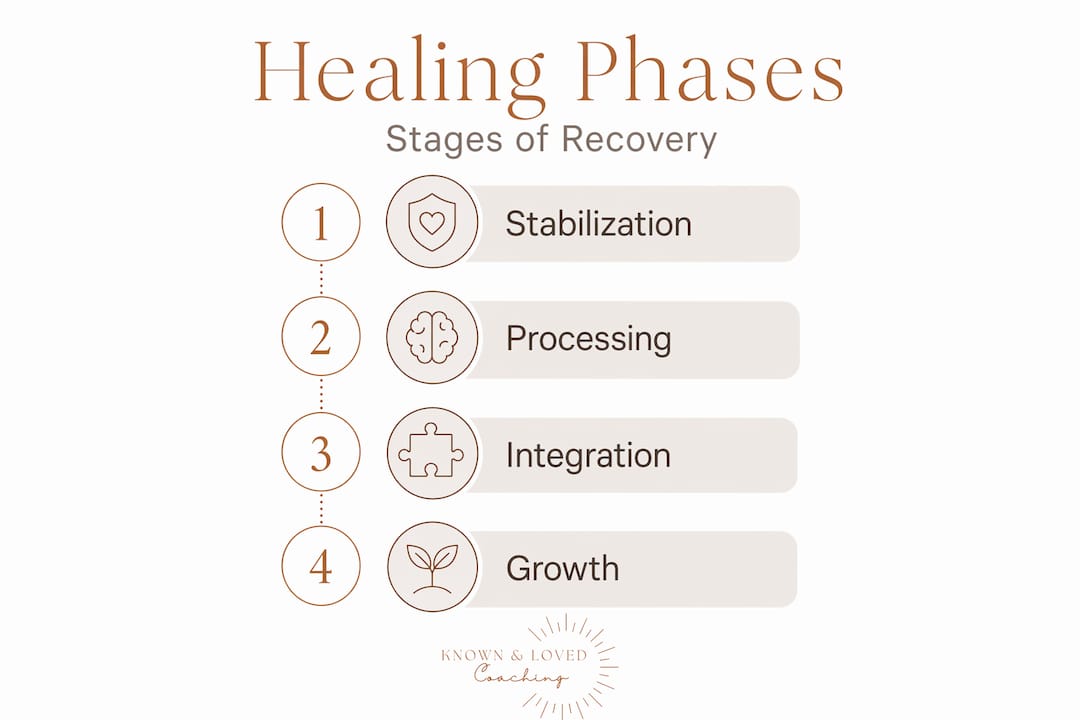
| Healing phase | What it looks like | Timeframe |
|---|---|---|
| Stabilization | Building safety, reducing crisis responses | Weeks to months |
| Processing | Engaging with trauma material | Months to years |
| Integration | Weaving meaning, expanding identity | Ongoing |
| Remodeling | Physical and neurological rewiring | Over 1 year |
Healing trauma: layers, emotions, and integration
Trauma healing does not happen all at once. It happens in layers, and your nervous system is the gatekeeper of that process. Healing progresses by layers, with the nervous system revealing deeper trauma only when it feels safe enough to do so. This means that earlier in your healing, you may only be able to touch the surface of what happened to you. Later, as your capacity grows, the deeper material becomes accessible.
This is why you might return to what feels like an old wound you thought you had already dealt with. You haven't gone backward. You've grown enough to face a layer that was simply unreachable before. Revisiting old wounds is often a sign of nervous system trust and progress, not a sign that you've failed.
Understanding these layers helps explain several truths that many people in healing struggle to believe:
- A memory or emotion you thought was resolved can resurface with new intensity, and that is growth at work.
- Feeling worse before feeling better is a recognized part of processing trauma, not a sign of getting it wrong.
- Grief, anger, and sadness can cycle back not because you're stuck, but because your heart is integrating something new.
- Your body may hold memories longer than your mind does. Somatic responses like tightness, fatigue, or anxiety can appear even when your thoughts feel settled.
Integration is what transforms painful experiences into wisdom. Without integration, people may misread a difficult stretch in healing as proof it isn't working, and they abandon the process too soon. Integration happens through therapy, honest conversation with safe people, journaling, prayer, and community. It creates the container that holds meaning and keeps you moving forward.
Pro Tip: When a familiar wound resurfaces, pause before calling it a setback. Ask yourself: "What might I be ready to see or feel now that I couldn't before?" That shift in framing can change everything.
Common myths about healing that keep you stuck
There is a phrase you may have heard when going through something hard: "Just bounce back." It sounds encouraging, but it actually misrepresents what healing requires. Resilience means integrating hard experiences into your life story, not returning to the person you were before the pain. You are not supposed to snap back. You are supposed to grow through.
These are some of the most common myths about the healing process that tend to do the most damage:
- "If I were really healing, I wouldn't still feel this." Recurring symptoms or old feelings don't mean you're failing. They often mean your nervous system has developed new capacity to process what it couldn't before.
- "Other people seem to be doing better than me." Comparisons with others hinder recovery. Your timeline is shaped by your unique history, your nervous system, your relationships, and your biology. Nobody else's pace is the right pace for you.
- "Healing means being symptom-free." True healing is about function, meaning, and integration. You can carry a scar and still live a full, connected life. The goal is not the absence of pain. It's the presence of peace.
- "I should be over this by now." Shame about your timeline is one of the most common obstacles in emotional healing. It creates pressure that actually slows the process down.
One of the most important reframes in understanding healing patterns is this: what looks like regression is often reorganization. Your mind and body are restructuring themselves at a deeper level. Reorganization is often mistaken as regression during emotional healing, but it is actually a sign that change is happening at a level deeper than the surface.
Practical ways to support your non-linear healing path
Knowing that healing is unpredictable is one thing. Learning to walk through it with grace is another. The following steps are grounded in research and in the real experience of people who have moved through trauma recovery with honesty and care.
-
Stay in consistent support. Effective healing involves consistent therapy, self-care practices, and lifestyle choices that support your nervous system. This doesn't mean every session will feel productive. It means you show up anyway, because momentum matters more than mood.
-
Normalize the hard days. Moments of falling apart help you identify unmet needs and ultimately strengthen your resilience. When a hard day comes, name it without judgment. "This is hard today" is not the same as "I am falling apart forever."
-
Use integration practices regularly. Journaling, prayer, somatic movement, and honest community conversation all help your mind and body make sense of what you've experienced. Integration isn't a one-time event. It's a daily practice of meaning-making.
-
Lean into relational support. Healing is relational and requires the presence of trusted others. Co-regulation, which is the calming effect of being in safe relationship with another person, helps your nervous system hold the weight of difficult emotional work. You were not designed to heal in isolation. Learning to manage stress naturally also supports your nervous system between therapy sessions and during particularly hard stretches.
-
Honor your unique rhythm. Your healing timeline is not a moral measure. It is not a reflection of your faith, your effort, or your worth. Trust that God's timing and your body's wisdom are working together, even when the path feels unclear.
My honest take on the non-linear healing path
I've walked this road myself, and I've sat with many women who felt the way you might feel right now. Confused. Exhausted. Ashamed that they aren't further along. And the hardest thing I've had to unlearn was the belief that a hard day meant I had lost ground.
Here is what I've come to know: the days when everything resurfaces are often the days when the deepest healing is happening. Your nervous system doesn't bring something to the surface unless it believes you can finally bear it. That's not a setback. That's an invitation.
What I've found is that the women who make the most lasting progress are not the ones who never stumble. They are the ones who stop measuring healing by how they feel on any given Tuesday. They start measuring it by the depth of their self-awareness, the gentleness of their own voice, and their growing ability to stay present even when things get hard.
Self-compassion is not a soft extra. It is the ground that makes everything else possible. When you stop fighting your own timeline and start trusting the process, healing begins to feel less like a test you're failing and more like a path you're actually walking.
— Kate
You don't have to walk this path alone

Healing from narcissistic and emotional abuse is some of the most courageous, layered work a person can do. At Known and Loved Coaching, we walk with Christian women through exactly this kind of non-linear healing journey, using faith-based somatic coaching, community, and practical tools grounded in God's truth. Whether you're in the thick of a hard season or looking for a safe place to go deeper, you deserve support that meets you exactly where you are. You are known. You are loved. And you do not have to figure this out alone.
FAQ
Why does healing feel like going backward?
What feels like going backward is often your nervous system processing a deeper layer of trauma that it wasn't ready to face before. Reorganization and regression look similar from the outside, but one means you're growing.
How long does emotional healing take?
Emotional healing timelines vary widely because healing is shaped by your history, nervous system, support system, and biology. Physical remodeling alone can take over a year, and emotional integration often continues long after that.
Are setbacks a normal part of recovery?
Yes. Setbacks are expected and recognized as part of learning and recovery. They help identify unmet needs and build resilience rather than signal that healing has stopped.
Does healing from trauma ever really end?
Healing is less about reaching a finish line and more about growing your capacity to live fully. Many people find that integration continues throughout life, bringing new depth and meaning rather than simply removing pain.
Why is comparing my healing to others harmful?
Every person's healing timeline is shaped by unique factors including their trauma history, relationships, and nervous system. Comparing your progress to someone else's creates shame that actively slows your own healing process.