

Many women expect faith to act as a buffer against pain. When trauma hits, especially the kind that comes from narcissistic or emotional abuse, that expectation can shatter. The role of faith in trauma recovery is far more complex than simply "pray and feel better." Faith can be both a source of deep comfort and a place of profound confusion. This guide walks you through what the research actually shows, where faith can genuinely help, and how to use spirituality as a real tool for healing without bypassing the pain that deserves to be felt.
Table of Contents
- Key takeaways
- How trauma disrupts faith and spirituality
- Evidence-based benefits of faith in healing trauma
- Challenges to watch for: spiritual bypassing and trauma-informed spirituality
- Practical ways to integrate faith into recovery
- Rebuilding faith and growing through the pain
- My perspective on faith and trauma
- You do not have to heal alone
- FAQ
Key takeaways
| Point | Details |
|---|---|
| Faith and trauma interact in complex ways | Spiritual doubt and crisis after trauma are normal responses, not signs of weak faith. |
| Research supports faith integration | Faith-integrated therapy links to 23% better outcomes for depression and anxiety versus secular programs alone. |
| Spiritual bypassing causes harm | Rushing toward peace before processing pain can block genuine healing and deepen disconnection. |
| Trauma-informed spirituality centers safety | Survivors need agency to pause or modify spiritual practices when they trigger distress. |
| Rebuilding faith is a valid part of recovery | Shifting or deepening beliefs after trauma is not failure. It is growth. |
How trauma disrupts faith and spirituality
Trauma does not stay in the mind. It lives in the body, in the nervous system, and yes, in the spirit. When something devastating happens, especially abuse from someone who may have used faith as a weapon or a cover, the spiritual world can feel just as unsafe as everything else.
This disruption has a name in psychological research. Anxiety Buffer Disruption Theory explains how trauma shatters the protective worldviews that normally buffer us against existential fear. Faith is one of the most powerful of those buffers. When trauma strikes, that buffer can collapse, leaving you feeling exposed, confused, and spiritually unmoored.
What does spiritual distress actually look like after trauma? It can show up in ways you might not immediately connect to faith:
- Feeling unable to pray or finding prayer hollow and empty
- Anger at God, or a deep sense that God was absent when you needed Him most
- Withdrawal from church, community, or rituals that once felt safe
- Doubt about whether your beliefs were ever real
- Shame about the doubt itself, which creates a painful second layer of suffering
"He heals the brokenhearted and binds up their wounds." — Psalm 147:3
This verse is true. And it is also true that healing is rarely instant. Spiritual struggle after trauma, including questioning God's power or goodness, is clinically significant and partially explains why PTSD develops in some survivors. Naming your spiritual pain as a real and valid part of your experience is not a detour from healing. It is the path.
Evidence-based benefits of faith in healing trauma
The research on spirituality and trauma recovery is genuinely encouraging. When faith is integrated thoughtfully and authentically into healing, the outcomes are measurable.

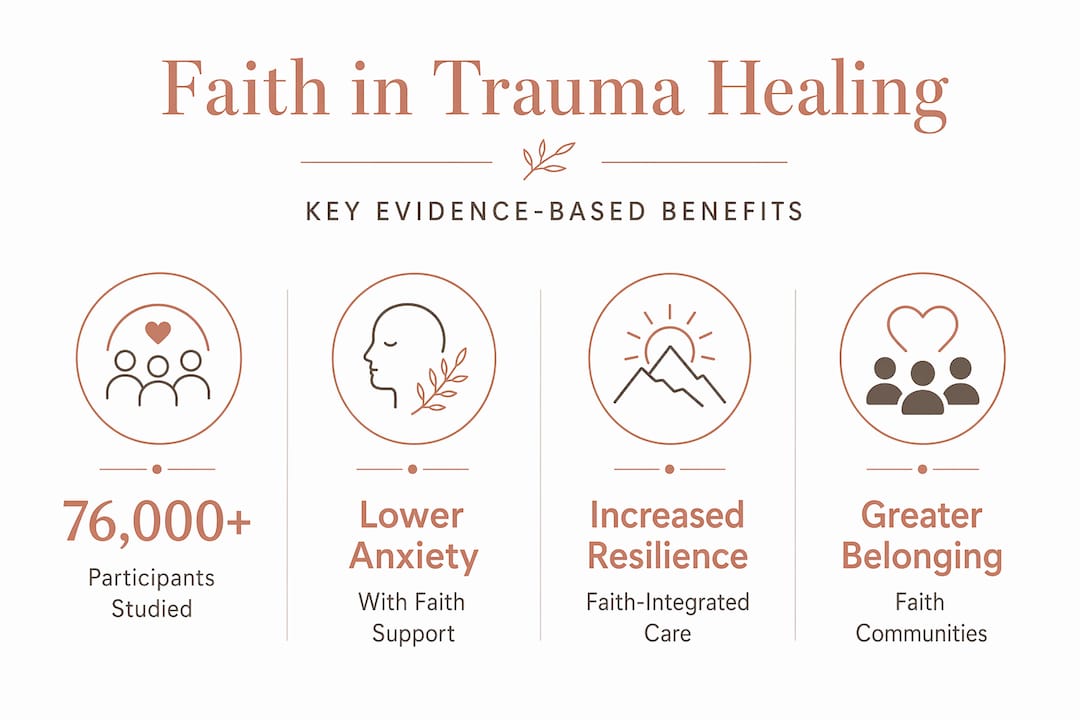
Studies involving nearly 80,000 participants found that strong spiritual ties reduce anxiety and depression while increasing life satisfaction. Faith communities can improve recovery rates by up to 45% compared to those healing in isolation. These are not small numbers.
Here is a clear look at how faith-integrated approaches compare to secular-only treatment:
| Recovery Outcome | Secular Therapy Alone | Faith-Integrated Therapy |
|---|---|---|
| Reduction in depression and anxiety | Moderate improvement | 23% greater reduction |
| Sense of meaning and purpose | Variable | Significantly higher |
| Social support and community | Depends on individual network | Built-in through faith community |
| Resilience over time | Moderate | Higher with spiritual connection |
| PTSD symptom reduction | Moderate | Enhanced with spirituality integration |
What makes faith so powerful in recovery? Part of the answer is meaning. Trauma strips away your sense of safety and purpose. Faith offers a "why" that secular frameworks often cannot. It gives suffering a context, even when that context is still being worked out. Spirituality reinstates meaning and helps restore the protective systems that trauma dismantled.
Pro Tip: If formal religious practice feels too heavy right now, start smaller. A single verse, a quiet moment of gratitude, or a honest conversation with God about your anger counts as spiritual practice. You do not need to perform faith to experience it.
Faith communities also provide something that therapy alone cannot fully replicate: belonging. Knowing you are seen, known, and loved by a community of people who share your values is deeply healing for nervous systems that have been conditioned to expect harm.
Challenges to watch for: spiritual bypassing and trauma-informed spirituality
Not all faith-based approaches to healing are created equal. One of the most common and quietly damaging patterns in Christian communities is spiritual bypassing. This is when spiritual language or practices are used to skip over the hard emotional work rather than move through it.
Spiritual bypassing sounds like being told to "just forgive and move on" before you have processed the depth of what was done to you. It sounds like "God has a plan" used to shut down grief. It feels like pressure to perform peace you do not yet have. Forcing spiritual practices when your nervous system is in survival mode can actually deepen harm, not heal it.
Trauma-informed spirituality takes a different approach. It honors where you actually are, not where you think you should be. Here is what that looks like in practice:
- Give yourself permission to feel anger. Anger at God, at the church, at the person who hurt you. These emotions are not spiritually dangerous. They are honest.
- Pause practices that trigger you. If attending church sends your nervous system into panic, that is information, not weakness. Trauma-informed spirituality promotes survivor agency to pause or modify practices until safety is restored.
- Seek communities that hold space for doubt. A faith community that cannot tolerate your questions is not a safe place for healing.
- Watch for pressure to perform forgiveness. Forgiveness is a process, not a deadline. Healing requires honoring all emotional states before moving toward release.
- Be cautious of leaders who use Scripture to control. This is especially relevant for survivors of narcissistic abuse, where spiritual language was often weaponized.
Pro Tip: When a spiritual practice triggers a stress response in your body, try grounding first. Feel your feet on the floor, take three slow breaths, and then decide whether to continue. Your nervous system needs to feel safe before it can receive comfort.
Mental Health America notes that religion and spirituality serve as protective factors against stress, but only when the experience is genuinely safe and chosen freely. Coerced or shame-based spirituality works in the opposite direction.
Practical ways to integrate faith into recovery
Knowing that faith can help is one thing. Knowing how to actually use it when you are in pain is another. Here are concrete steps for weaving faith into your healing process in a way that respects your nervous system and your whole person.
-
Find a trauma-informed spiritual care provider. Not every pastor or counselor understands trauma. Look for clergy or spiritual directors who have specific training in trauma-sensitive care. Over 33% of clergy serve frontline mental health roles but often feel overwhelmed. A well-trained provider makes a significant difference.
-
Start with the smallest spiritual practice that feels safe. This might be reading one verse in the morning, lighting a candle as a prayer, or simply sitting in silence and telling God you are there. Gentleness with yourself is not spiritual laziness. It is wisdom.
-
Combine faith practices with clinical treatment. Christian holistic trauma treatment combines modalities like EMDR and CBT with biblical truth to address mind, body, and spirit together. Faith and therapy are not competing. They work better together.
-
Build or find a community that understands trauma. Isolation slows healing. A group of women who have walked through similar pain and hold onto faith together provides something irreplaceable.
-
Explore new expressions of faith. If your old practices feel tied to painful memories or people, it is okay to try something new. Journaling prayers, nature walks as worship, or somatic practices grounded in Scripture can open fresh pathways to God.
-
Balance hope with honesty. You do not have to choose between trusting God and acknowledging how much you hurt. Both can be true at the same time.
Rebuilding faith and growing through the pain
Here is something the church does not always say clearly enough: having your faith shaken is not the same as losing it. For many survivors, the faith that emerges after trauma is deeper, more honest, and more personal than what they had before.
Some survivors shift from viewing God as an all-controlling force who should have prevented their suffering to a God who weeps with them, who is present in the pain rather than absent from it. That theological shift is not a compromise. For many women, it is the beginning of a faith that can actually hold them.
Rebuilding faith after trauma involves a few key realities:
- Healing is not linear. You may feel close to God one week and completely disconnected the next. Both are part of the process.
- Your evolving beliefs are valid. If your understanding of God, prayer, or Scripture is changing, that is not spiritual failure. It is spiritual growth.
- Grief and faith can coexist. You are allowed to mourn what was taken from you, including the version of faith you once had, while still reaching toward God.
- Meaning-making takes time. You do not have to understand why this happened to begin healing from it.
Trauma disrupts spiritual protective systems, but it also opens a pathway to transformative acceptance and spiritual growth that would not have been possible otherwise. That does not make the trauma okay. It means God can work in and through even the most broken places.
My perspective on faith and trauma
I have walked alongside women in the deepest valleys of their healing, and one thing I have learned is that the pressure to "get back to faith quickly" is one of the most isolating experiences a trauma survivor can face. When you are told your doubt is a problem to fix rather than a wound to tend, you end up hiding the very pain that needs to be seen.
What I have found actually works is this: meeting women exactly where they are, without rushing them toward peace they have not yet earned. Doubt is not the opposite of faith. Anger at God is not rebellion. They are honest conversations with a God who can handle them.
I have also seen what happens when clinical healing and faith work together. Women who once could not say the word "prayer" without flinching begin to find their way back to God, not the God who was used against them, but the God who knew them before any of this happened. That kind of healing is real. It is slow. And it is worth every step.
The most dangerous thing I see in faith-based spaces is the quick fix. The promise that if you just forgive fast enough, pray hard enough, or believe strongly enough, the trauma will lift. It will not. But with the right support, faith can become one of the most powerful resources you have.
— Kate
You do not have to heal alone
If you are a Christian woman healing from narcissistic or emotional abuse, you deserve support that understands both your trauma and your faith.

At Knownlovedcoaching, we offer faith-based somatic coaching designed specifically for women like you. Our approach combines trauma-informed care with Scripture, community, and practical tools that help your nervous system and your spirit heal together. You are not too broken. You are not too far gone. You are known and you are loved. Visit Knownlovedcoaching to explore coaching, courses, and a community of women who understand what you are carrying and believe healing is possible for you.
FAQ
What is the role of faith in trauma recovery?
Faith can serve as a source of meaning, community, and resilience during trauma recovery. Research shows that faith integration improves recovery outcomes for depression and anxiety by 23% compared to secular therapy alone.
Can faith help with trauma even when I have doubts?
Yes. Spiritual doubt after trauma is a normal and clinically recognized response. Honoring your doubt honestly is part of trauma-informed spirituality, not a barrier to healing.
What is spiritual bypassing and why does it matter?
Spiritual bypassing is using faith or spiritual language to avoid processing painful emotions. It can deepen harm by forcing spiritual practices before the nervous system is ready to receive them safely.
How do I start using faith in my healing without feeling overwhelmed?
Start with the smallest practice that feels safe, such as one verse, one quiet moment, or one honest prayer. Trauma-informed spirituality emphasizes gradual, self-directed engagement rather than pressure to perform.
Should faith-based healing replace therapy?
No. Faith-based healing works best alongside clinical treatment. Combining approaches like EMDR or CBT with spiritual practices addresses mind, body, and spirit together for more lasting transformation.