

Trauma from emotional abuse doesn't just live in your memories. It lives in your body, your nervous system, and the quiet moments when you wonder if you'll ever feel whole again. If you've been searching for scripture verses for healing trauma, you're not alone, and you're not without hope. God's Word has met broken people in their darkest places for thousands of years. It can meet you there too. This guide offers carefully chosen healing scriptures alongside practical ways to actually use them, so they move from the page into your heart.
Table of Contents
- Key takeaways
- Scripture verses for healing trauma: where to begin
- Key bible verses for healing trauma and emotional abuse
- How to engage scripture for healing: a practical approach
- Overcoming spiritual and emotional obstacles
- My honest perspective on healing through scripture
- Ready to go deeper in your healing?
- FAQ
Key takeaways
| Point | Details |
|---|---|
| Scripture is active, not passive | Reading healing scriptures slowly and with intention transforms them from words into personal comfort and truth. |
| Start with one verse | Focusing on a single trauma recovery scripture prevents overwhelm and builds a sustainable healing practice. |
| Vulnerability in prayer matters | God honors honest, raw prayers, just as He honored David and Hezekiah's cries of grief. |
| Healing is not linear | Spiritual and emotional healing takes time; small, consistent steps with scripture renew your mind over weeks and months. |
| Community strengthens healing | Sharing scripture with a trusted prayer partner or faith-based counselor deepens your recovery and reduces isolation. |
Scripture verses for healing trauma: where to begin
Before you open your Bible, it helps to understand why scripture works for trauma healing. This isn't wishful thinking. God's Word carries a living quality that speaks directly to pain. Hebrews 4:12 describes it as "alive and active," able to reach the deepest parts of who you are, including the parts that emotional abuse has wounded.
The mindset you bring matters. You don't need to feel strong, faithful, or even hopeful to start. You just need to show up. Think of scripture the way you'd think of a warm, steady hand reaching toward you. You don't have to fully grasp it. You just have to let it touch you.
To get started, gather a few simple tools:
- A Bible (a translation you can read comfortably, such as the NIV, ESV, or NLT)
- A journal to write down what surfaces as you read
- A quiet space where you feel physically safe
- A short prayer to open your heart before you read, even just "God, I need You here"
Pro Tip: Start with just five minutes a day. One verse, read slowly, is more healing than ten verses read quickly. Be patient with yourself. This is not a race.
Experts recommend beginning with manageable practices and viewing scripture as ongoing support rather than a quick fix. That framing alone can take the pressure off and let you actually receive what God has for you.
Key bible verses for healing trauma and emotional abuse
These are not random verses pulled from a list. Each one speaks directly to the experience of a woman who has been hurt, dismissed, controlled, or broken down by someone she trusted.
Here is a summary table of the most powerful trauma recovery scriptures, followed by deeper context for each:
| Scripture | Theme | Why it matters for trauma |
|---|---|---|
| Psalm 147:3 | Healing and restoration | God actively heals the brokenhearted |
| Psalm 34:18 | God's closeness | He is near in your darkest moments |
| Isaiah 41:10 | Courage and strength | God's presence replaces fear with steadiness |
| Psalm 23:4 | Protection and comfort | You are not alone in the valley |
| John 14:27 | Peace | God's peace surpasses what the world offers |
| Philippians 4:6-7 | Mental renewal | Prayer guards your mind and heart |
Psalm 147:3
"He heals the brokenhearted and binds up their wounds" is perhaps the most foundational verse for emotional healing. It appears in over 90% of curated lists for trauma recovery, and for good reason. It doesn't say God might heal. It says He does. That certainty is something to hold onto when your own certainty feels shaky.

Psalm 34:18
The Lord is close to the brokenhearted and saves those who are crushed in spirit. Emotional abuse often creates a crushing sense of worthlessness. This verse directly counters that lie. God is not far away, watching from a distance. He is close. Right there with you.
Isaiah 41:10
"Do not fear, for I am with you" is cited in about 80% of healing resources addressing fear and anxiety. Trauma survivors often live with a constant undercurrent of fear, even when the danger has passed. This verse is a direct promise: you are not facing this alone, and God's strength is available to you right now.
Psalm 23, John 14:27, and Philippians 4:6-7
These verses address holistic healing across mind, body, and spirit. Psalm 23 walks you through the valley without pretending it isn't dark. John 14:27 offers a peace that doesn't depend on your circumstances changing. Philippians 4:6-7 gives you something to do with anxiety: bring it to God in prayer and receive a peace that guards your mind. That's scripture for emotional healing that is both spiritual and practical.
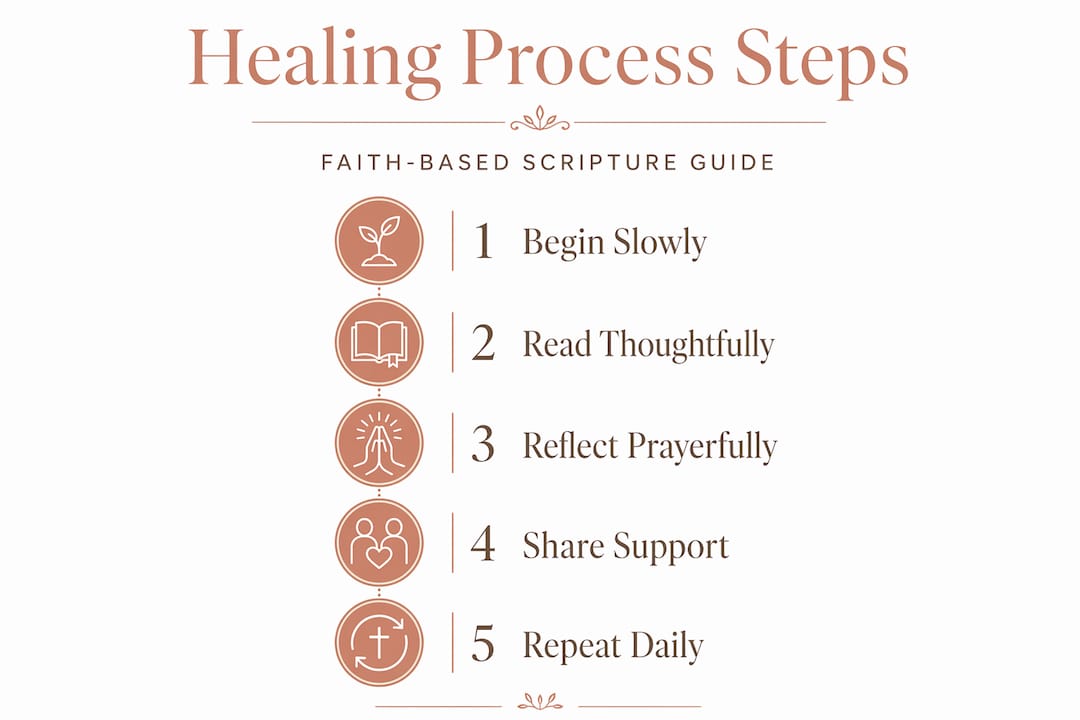
How to engage scripture for healing: a practical approach
Knowing the verses is one thing. Letting them reach your wounded places is another. Here is a step-by-step process that works, especially for women healing from emotional abuse.
-
Select one verse. Don't try to work through a long list. Choose a single verse that resonates with where you are today. Psalm 34:18 is a good starting point if you feel alone. Isaiah 41:10 works well if fear is dominant.
-
Read it slowly, out loud if possible. Hearing your own voice speak God's truth over yourself has a grounding effect. Read it two or three times. Let each word land.
-
Journal what comes up. Write down your honest response. If the verse feels distant or hard to believe, write that. If it brings tears, write that too. Your journal becomes a record of God meeting you over time.
-
Pray vulnerably. You don't need polished words. God honors raw grief and honest cries, just as He honored David's prayers in the Psalms and Hezekiah's tearful prayer in Isaiah 38. King Hezekiah wept and prayed honestly, and God responded to his prayer by adding fifteen years to his life. Your tears are not weakness. They are a language God understands.
-
Repeat consistently over time. Return to the same verse for several days before moving on. Repetition is how scripture moves from your head into your heart. Healing is not instant but an ongoing process where small, consistent engagement with scripture renews your mind and strengthens your faith over time.
Pro Tip: Consider sharing your chosen verse with a trusted friend or prayer partner. Saying it aloud to someone who loves you creates a layer of accountability and connection that deepens healing.
Overcoming spiritual and emotional obstacles
There will be days when scripture feels flat. When God feels silent. When you read the words and feel nothing. That is not a sign that healing isn't happening. It is a sign that you are human.
Psalm 22 is one of the most honest prayers in all of Scripture. It opens with "My God, my God, why have you forsaken me?" That is not a polished prayer. That is a cry from the gut. And yet God preserved it in His Word, which means He welcomes that kind of honesty from you too.
"Suffering and feelings of divine silence are normal parts of spiritual growth. God remains faithful to hear and answer prayers, even when we cannot feel His presence."
Non-linear healing is real. You may feel peace one week and grief the next. That is not failure. That is the actual shape of recovery from trauma. Be gentle with yourself on the hard days. Give yourself permission to simply sit with a verse without needing it to fix everything immediately.
When emotional overwhelm hits, step back. Take a walk. Rest. Come back to scripture when you have a little more space. God is not going anywhere, and His promises do not expire. The verses for overcoming trauma that you've been meditating on are still true on the days you can't feel them.
My honest perspective on healing through scripture
I've walked alongside many women who came to scripture for healing feeling skeptical, exhausted, or just plain numb. What I've learned is that the women who experience the deepest transformation are not the ones who had the most faith at the start. They are the ones who kept showing up, even when it felt like nothing was happening.
In my experience, the biggest mistake is treating bible verses for healing like a prescription. You take the verse, you feel better, done. Real healing doesn't work that way. Scripture is more like water than medicine. It works slowly, consistently, and it changes you from the inside out in ways you don't always notice until you look back.
What I've also seen is that vulnerability is the key that unlocks scripture's power. When you stop trying to read it "correctly" and start bringing your actual pain to it, something shifts. The words stop being words and start being a conversation with a God who already knows every detail of what you've been through.
I believe with everything in me that God sees your tears. He saw Hezekiah's. He saw David's. He sees yours. And He is not indifferent. He is at work, even in the quiet.
— Kate
Ready to go deeper in your healing?
If these scripture verses for healing trauma have stirred something in you, and you're ready for more than reading alone, Knownlovedcoaching was built for exactly where you are right now.

Knownlovedcoaching offers faith-based somatic coaching designed specifically for Christian women healing from narcissistic and emotional abuse. The work integrates scripture, prayer, and body-based healing tools to help you move from surviving to feeling truly known and loved. You don't have to figure this out alone. Personalized support, a caring community, and a coach who understands your story are waiting for you. Take the next step toward wholeness today.
FAQ
What are the best scripture verses for healing trauma?
Psalm 147:3, Psalm 34:18, and Isaiah 41:10 are among the most widely cited scripture verses for healing trauma, offering promises of God's closeness, active healing, and strength in fear.
How do I use bible verses for healing emotional abuse?
Choose one verse that speaks to your current pain, read it slowly and out loud, journal your response, and pray honestly. Repeating this practice daily over several weeks allows scripture to move from your mind into your heart.
Is it normal to feel nothing when reading healing scriptures?
Yes. Feeling spiritually dry or numb is a normal part of trauma recovery. Psalm 22 models honest prayer in suffering, and experts confirm that spiritual silence is part of growth, not a sign that God has left you.
Can scripture help with trauma from emotional abuse specifically?
Absolutely. Verses like Psalm 34:18, which speaks to those who are crushed in spirit, and Isaiah 41:10, which addresses fear, speak directly to the wounds that emotional abuse creates, including worthlessness, fear, and isolation.
How long does it take to heal with scripture?
There is no fixed timeline. Healing is an ongoing process where consistent, small engagement with scripture renews your mind over time. Most women find that combining scripture with community support and practical tools deepens and accelerates their healing.