

You have probably heard that healing is something you do on your own. That with enough prayer, enough willpower, and enough determination, you can regulate your emotions and find your way back to peace. But that belief misses something deeply important, something rooted in how God designed your nervous system. Co-regulation healing explained through a trauma-informed lens reveals that your body was never meant to find safety alone. For women recovering from narcissistic abuse and emotional trauma, understanding co-regulation is not just interesting. It is life-changing.
Table of Contents
- Key takeaways
- Co-regulation healing explained: your nervous system needs connection
- How trauma changes your ability to self-regulate
- Practical ways to experience co-regulation in healing
- The benefits of co-regulation for emotional well-being
- My perspective on why co-regulation changes everything
- Start your healing with Known and Loved Coaching
- FAQ
Key takeaways
| Point | Details |
|---|---|
| Healing is not solo work | Your nervous system is designed to find safety through connection with other regulated people. |
| Trauma disrupts self-regulation | Abuse and trauma damage your ability to self-regulate, making co-regulation a necessary first step in recovery. |
| One regulated person is required | Co-regulation only works when at least one person in the relationship is calm and grounded. |
| Practical tools exist | Breathing together, a soothing voice, and safe presence are all co-regulation techniques you can use today. |
| Benefits extend beyond therapy | Consistent co-regulation experiences build long-term emotional resilience, empathy, and healthier relationships. |
Co-regulation healing explained: your nervous system needs connection
Co-regulation is the process by which one person's calm, regulated nervous system helps another person's dysregulated nervous system return to a state of safety. It is not just emotional support. It is a physiological event happening in your body in real time.
To understand this, you need a quick look at your autonomic nervous system. This is the part of your nervous system that runs below conscious awareness and controls your stress responses. When you sense danger, it activates fight, flight, or freeze. When you feel safe, it shifts into a calm, connected state. For women who have lived through abuse, the nervous system gets stuck in survival mode. Your body has learned that people are unsafe, that the world is unpredictable, and that you must stay on high alert to survive.
Polyvagal Theory, developed by Dr. Stephen Porges, offers a helpful framework here. It explains that your nervous system is constantly scanning for cues of safety or danger in your environment, a process called neuroception. When you are around someone whose nervous system is calm and regulated, your own nervous system picks up on those cues. Their slow breathing, soft tone of voice, and relaxed body language send your nervous system the message: you are safe here.
Research confirms this is more than just perception. Social engagement produces biobehavioral synchrony across heart rate, skin conductance, and respiration. Your body literally begins to synchronize with the body of a regulated person nearby. This is called physiological coupling, and it is the biological foundation of co-regulation.
Here is what this looks like in practice:
- You call a calm, grounded friend after a hard day, and your racing heart starts to slow.
- A therapist speaks to you in a steady, warm tone, and your shoulders drop from around your ears.
- You sit in prayer with a trusted mentor, and the tight feeling in your chest begins to release.
Pro Tip: You do not have to talk through every painful detail to experience co-regulation. Sometimes just sitting with a regulated, safe person in silence is enough to help your nervous system begin to settle.
How trauma changes your ability to self-regulate
Here is something that many people do not realize: self-regulation is not a skill you are born with. You learn it, as a child, by borrowing it from the people around you. Caregiver-infant co-regulation is a bidirectional process where children develop self-regulation by borrowing their caregiver's calm. When a parent soothes a crying baby with a gentle voice and slow rocking, the baby's nervous system starts to match the parent's. Over thousands of these interactions, the child's brain builds neural pathways for managing big emotions on its own.
But what happens when that early co-regulation was absent, chaotic, or harmful? What happens when the person who was supposed to be your safe harbor was the source of your fear?
"He heals the brokenhearted and binds up their wounds." Psalm 147:3. Healing is God's design for you, and co-regulation is one of the beautiful ways He built that healing into human connection.
For women who grew up in homes without consistent emotional safety, or who experienced abuse from a partner they trusted, the development of self-regulation gets interrupted. Harsh parenting disrupts a child's physiological regulation, causing a slower return to baseline stress levels and greater overall dysregulation. The nervous system never got the repeated experience of being brought back to calm by a safe person.
This is why willpower alone cannot heal trauma. Your nervous system is not looking for logic. It is looking for safety. And safety, in the body's language, is often found in another regulated human being.

This is also why co-regulation therapy is so central to trauma recovery. Before a trauma-informed therapist can help you process what happened to you, your nervous system must first be able to tolerate the work. Polyvagal-informed therapy uses co-regulation to expand a client's window of tolerance before trauma processing can occur. The therapist's regulated nervous system becomes a kind of external scaffold, holding safety while your own capacity for regulation grows.
Key disruptions trauma causes to self-regulation include:
- Difficulty returning to calm after stress, even minor stress
- Feeling emotionally flooded or completely shut down
- Chronic hypervigilance, always waiting for something to go wrong
- Difficulty trusting your own perceptions and feelings
- Deep loneliness, even in the presence of others
Practical ways to experience co-regulation in healing
Understanding co-regulation is one thing. Experiencing it is another. Here are practical ways co-regulation shows up in trauma recovery, and how you can begin to access it.
-
Find a regulated anchor. This could be a trauma-informed therapist, a somatic coach, a pastor, or a safe friend. The key word is regulated. Co-regulation requires at least one regulated partner. If both people are dysregulated, nervous systems escalate each other rather than calm down. You need someone who can stay grounded even when you cannot.
-
Use breath as a shared tool. Controlled breathing activates the parasympathetic nervous system and is most effective when practiced together. When a therapist or trusted person breathes slowly and audibly alongside you, your mirror neurons respond. You begin to breathe like they breathe. Your body follows.
-
Allow safe physical presence. A regulated person sitting nearby, making gentle eye contact, or offering a calm touch can signal safety to a dysregulated nervous system. You do not need to process trauma out loud for this to work. Presence itself is medicine.
-
Join a safe community. Group healing environments, like faith-based recovery communities or trauma-informed support groups, create collective co-regulation. Multiple regulated people in a space amplify the safety signals available to everyone present.
-
Receive consistent, repeated experiences of calm. Co-regulation is not a one-time fix. It works through repetition. Each time your nervous system returns to safety in the presence of a grounded person, you are building new neural pathways. Over time, those pathways become your own capacity for self-regulation.
Pro Tip: When you are in a co-regulation session with a therapist or coach, pay attention to your body, not just your thoughts. Notice when your breathing slows, when your jaw unclenches, when your stomach softens. Those physical shifts are your nervous system accepting the signal of safety.
A word of caution: be discerning about who you co-regulate with. If you are spending most of your time with people who are chronically anxious, volatile, or reactive, your nervous system may be doing the opposite of healing. For women recovering from abusive relationships, parallel parenting frameworks and other protective relational structures can help you limit contact with dysregulating people while you build your own capacity.
The benefits of co-regulation for emotional well-being
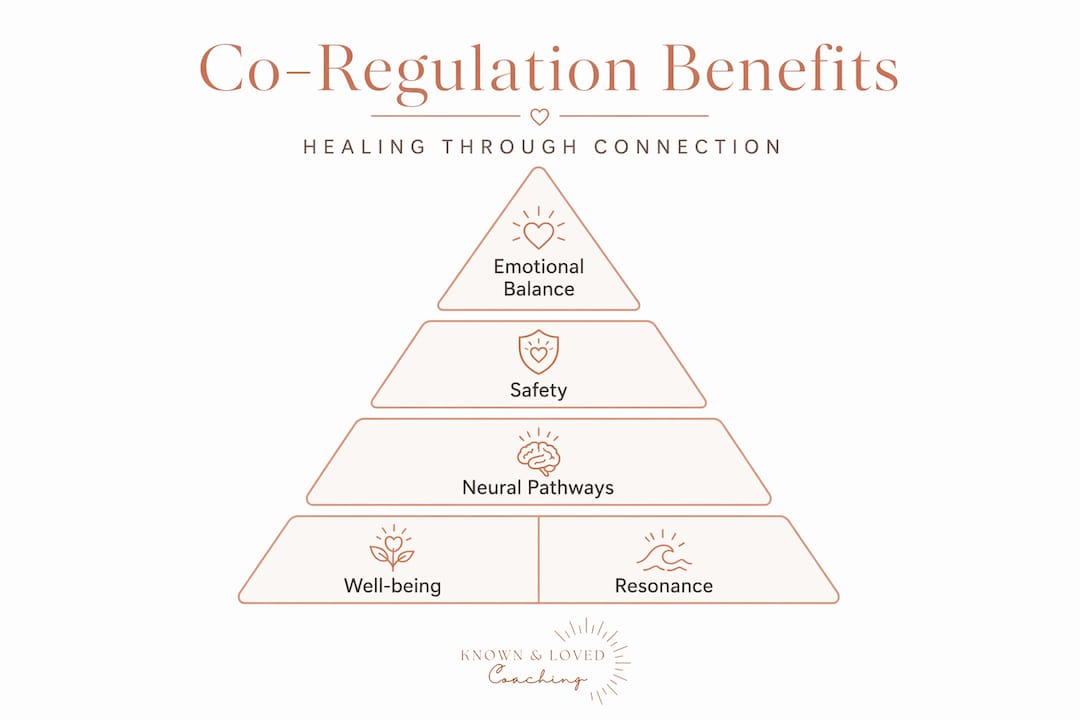
Co-regulation healing is not only for crisis moments. Its benefits extend deeply into your overall emotional health, your relationships, and your connection to yourself and God.
Consistent co-regulation experiences build neural pathways in the prefrontal cortex that support emotional balance and impulse control. Children who receive enough co-regulation tend to develop higher emotional intelligence and healthier relationships as adults. And the extraordinary truth is that healing can happen at any age. Your brain remains capable of building new pathways throughout your lifetime.
| Without co-regulation support | With consistent co-regulation |
|---|---|
| Chronic hypervigilance and anxiety | Gradual return to a sense of safety |
| Difficulty trusting others | Growing capacity for secure connection |
| Emotional flooding or numbness | Expanding window of emotional tolerance |
| Isolation and shame | Community, belonging, and empathy |
| Stuck in survival responses | Access to creativity, faith, and joy |
The broader benefits of co-regulation in relationships and everyday life include:
- Deeper empathy for yourself and others
- Greater ability to stay present during difficult conversations
- Reduced reactivity to stress triggers
- Increased resilience when life feels hard
- A felt sense of being loved and not alone
Inter-brain and body-to-body coupling coordinate emotional resonance between people in close relationship. When you begin to experience safe, regulated connection consistently, your entire emotional world begins to shift. You become more able to trust, more able to receive love, and more able to extend grace to yourself.
My perspective on why co-regulation changes everything
I have walked alongside women in the deepest valleys of trauma recovery, and here is what I have found to be true. The women who try to heal entirely alone, through information, self-help books, and private determination, often make progress only to hit a wall. That wall is the nervous system. You cannot think your way past a traumatized body.
What I have seen change everything is the experience of being held by a regulated, safe presence. Not fixed. Not lectured. Held. This is what a grounded therapist offers. It is what a healthy faith community can offer. It is what I seek to offer through my work at Known and Loved Coaching. When you are in the presence of someone whose nervous system says, "you are safe," something in your body begins to believe it, sometimes for the first time.
I have also seen the harm that comes from co-regulating with the wrong people. Women recovering from narcissistic abuse often stay connected to chaotic, dysregulated relationships out of familiarity, even when those relationships are making healing impossible. Being around someone who is volatile or unpredictable does not just feel hard. It actively trains your nervous system back into survival mode.
My honest encouragement to you is this: healing is not about being stronger or more disciplined. It is about finding the regulated, trustworthy people God places in your path and allowing yourself to receive what they offer. He designed you for connection. Co-regulation is not weakness. It is how you were made.
— Kate
Start your healing with Known and Loved Coaching
If this resonates with you, you are not alone. At Known and Loved Coaching, women healing from narcissistic and emotional abuse find a faith-centered space where co-regulation is woven into every session. Through somatic coaching grounded in Polyvagal Theory, you will experience what it feels like to have a regulated, compassionate presence walk beside you in the healing process. You do not have to white-knuckle your way through recovery. God designed your nervous system to heal in safe community, and that is exactly what Known and Loved Coaching exists to provide. You are seen, you are known, and you are deeply loved.
FAQ
What is co-regulation healing?
Co-regulation healing is the process of using the calm, regulated nervous system of another safe person to help your own nervous system return to a state of safety and balance. It is a physiological process, not just emotional support.
How does co-regulation work in the body?
When you are near a regulated person, your body synchronizes with theirs through shared cues like breathing rhythm, voice tone, and heart rate. Research shows that bodies become interconnected during close social interaction, which is the biological mechanism behind co-regulation.
Why is co-regulation important for trauma recovery?
Trauma gets stored in the nervous system and disrupts your ability to self-regulate. Co-regulation provides an external anchor of safety that allows your nervous system to settle before healing can occur, which is why it is foundational in trauma-informed therapy.
Can two dysregulated people co-regulate each other?
No. Effective co-regulation requires at least one regulated partner. When both people are dysregulated, their nervous systems escalate each other rather than restore calm, making it important to seek out grounded, safe connections for healing.
How do I know if I am experiencing co-regulation?
Signs that co-regulation is happening include slower breathing, a softening of tension in your body, reduced heart rate, and a growing sense of calm and safety in the presence of another person.