

Healing from trauma is not simply a matter of talking through what happened. Body awareness in trauma recovery offers something that words alone cannot: a way to release what your nervous system has been holding, often for years. If you've survived narcissistic or emotional abuse, you may feel disconnected from your own body, like a stranger in your own skin. That disconnection is a protective response, not a flaw. This guide walks you through what body awareness actually means, why it works, and how to begin practicing it gently, at a pace that honors your nervous system.
Table of Contents
- Key takeaways
- Body awareness in trauma recovery: what it actually means
- Titration and pendulation: pacing your healing safely
- Practical body awareness techniques for trauma survivors
- The neuroscience behind body awareness and trauma healing
- Common challenges in developing body awareness
- My perspective on pacing and why it changes everything
- How Known and Loved Coaching can support your healing
- FAQ
Key takeaways
| Point | Details |
|---|---|
| Trauma lives in the body | Recovery requires addressing physical sensations, not just memories or thoughts. |
| Three types of body awareness matter | Interoception, proprioception, and spatial awareness each play a distinct role in healing. |
| Pacing prevents overwhelm | Titration and pendulation keep your nervous system safe while you process trauma. |
| Practical techniques build trust | Grounding, breath awareness, and somatic tracking rebuild your relationship with your body over time. |
| Small steps create lasting change | Regular, gentle practice during stable moments forms the foundation for deeper healing. |
Body awareness in trauma recovery: what it actually means
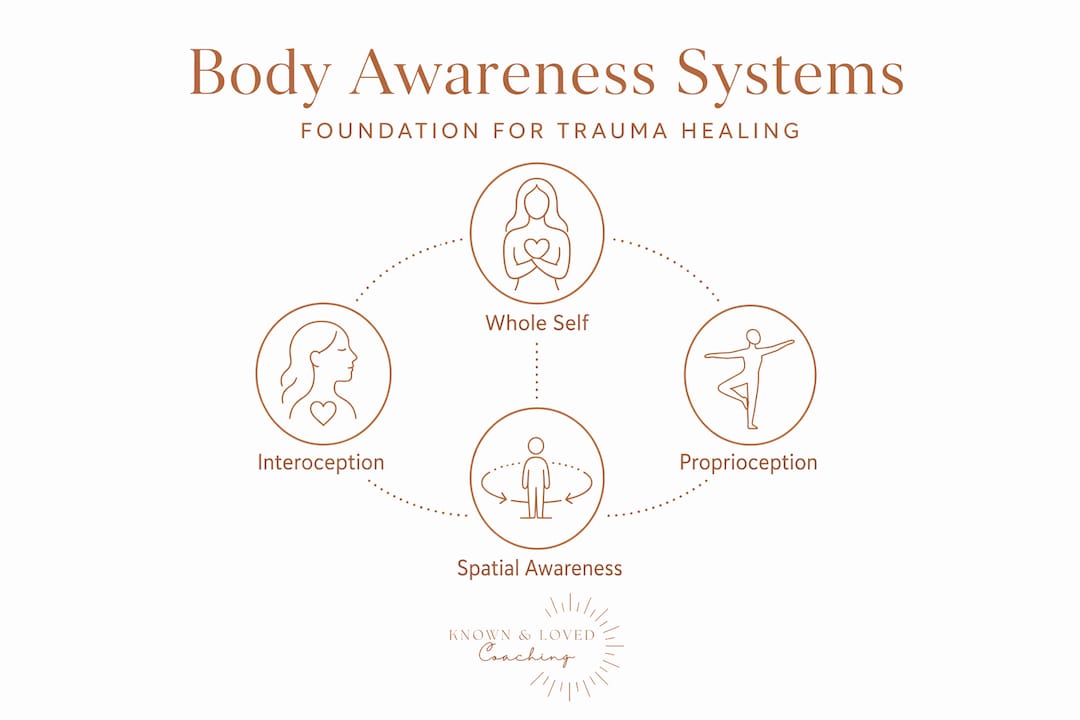
When trauma research talks about body awareness, it refers to three distinct but connected systems: interoception, proprioception, and spatial awareness. Understanding each one helps you know what you're actually developing when you practice.
Interoception is your ability to sense what's happening inside your body. Heart rate, hunger, tightness in your chest, a lump in your throat. These are interoceptive signals. Body awareness in trauma work includes tracking interoception alongside posture, breath pattern, and readiness to move as real, valid sensations worth noticing.
Proprioception is your sense of where your body is in space and how it's moving. It's the reason you can walk without watching your feet. Trauma can dull this system, leaving survivors feeling physically unsteady or "floaty."

Spatial awareness is your perception of your body in relation to the environment around you, like knowing how close you are to a wall or how much space you're taking up in a room.
Here's a simple comparison of these three types and how trauma affects each one:
| Awareness type | What it tracks | How trauma affects it | Example practice |
|---|---|---|---|
| Interoception | Internal body signals | Numbing, heightened reactivity | Noticing heartbeat or breath rhythm |
| Proprioception | Body position and movement | Clumsiness, disconnection | Slow intentional walking |
| Spatial awareness | Body in relation to space | Feeling invisible or too exposed | Orienting to a room by scanning slowly |
- Interoception is often the most disrupted in trauma survivors, especially those who experienced chronic emotional abuse.
- Proprioception practices are particularly grounding for women who feel unmoored or physically unsafe.
- Spatial awareness exercises can restore a sense of agency and physical presence.
Developing all three creates a fuller, more stable relationship with your body. That relationship is the foundation of the mind-body connection in healing that somatic approaches are built on.
Titration and pendulation: pacing your healing safely
One of the most important things to understand about somatic therapy for trauma is that healing cannot and should not be rushed. Two specific pacing tools, titration and pendulation, make the difference between trauma integration and retraumatization.
Titration means approaching trauma in very small doses. Rather than diving into the full weight of a memory or sensation, you take one small touch of activation and then return to safety. Think of it as turning up a dimmer switch one tiny notch at a time instead of flipping on a floodlight. Titration and pendulation work together as "dose and rhythm," small activations followed by reliable returns to your resources.
Pendulation is the rhythmic swinging between a state of activation and a state of settled safety. Pendulation expands your nervous system's capacity to tolerate arousal by building in that intentional return to calm, over and over. It does not suppress the difficult feelings. It teaches your nervous system that it can move through them and come back.
Here is a simple way to practice pendulation on your own:
- Find a place in your body that feels relatively neutral or even pleasant right now. A warm hand, relaxed shoulders, the feeling of your feet on the floor. This is your resource.
- Gently bring a small, tolerable amount of attention to an area of tension or discomfort. Stay there for just a few seconds.
- Return your attention fully back to your resource. Breathe. Notice the contrast.
- Repeat this movement slowly two or three times, never forcing yourself to stay in the uncomfortable place.
- End by resting completely in your resource for at least thirty seconds.
The body's natural rhythm between activation and calm is disrupted by trauma. Pendulation restores it by creating new neural pathways for moving between states.
Pro Tip: Watch for these signs that it's time to pause and return to your resource: your breathing becomes shallow or stops, you feel a sudden wave of nausea or dizziness, your vision narrows, or you lose awareness of where you are. These are your nervous system's signals that it has reached its limit. Honor them.
Practical body awareness techniques for trauma survivors
Building body awareness does not require a therapist's office. These practices are gentle, non-invasive, and designed to help you reconnect with your body without pushing into overwhelm.
-
The 5-4-3-2-1 sensory grounding exercise. Name five things you can see, four you can touch, three you can hear, two you can smell, and one you can taste. Grounding exercises like this help you regain regulation by reconnecting with the present moment through your senses. They are meant to be gentle and optional, not forced.
-
Breath awareness as somatic tracking. Breath awareness acts as an immediate bridge back to your body. You do not try to control or fix your breath. You simply notice it without judgment. Is it shallow? Fast? Does it catch? Just observe.
-
Tension and release practices. Slowly tense a single muscle group, such as your hands or shoulders, hold for five seconds, then release. Notice the difference in sensation. This helps move stored activation out of the tissues and teaches your body that it can change states.
-
Somatic body scan. Starting at your feet and moving upward, gently notice whatever sensations are present. Warmth, pressure, numbness, tingling. You are not trying to fix anything. Somatic tracking is most effective when paired with full permission to observe without immediately trying to analyze or resolve.
-
Slow intentional movement. Walking slowly and deliberately, noticing each foot as it lifts and lands, engages proprioception and brings you back into your physical self with very little risk of activation.
Pro Tip: Practice these techniques during calm, stable moments, not only in crisis. Grounding practice done regularly during stable periods creates access points your nervous system can return to when things get hard. You are essentially teaching your body where "safe" is.
The neuroscience behind body awareness and trauma healing
Understanding why body awareness works can make it easier to trust the process. Your autonomic nervous system governs your body's survival responses, and trauma can leave it stuck in either overdrive or shutdown. Polyvagal therapy teaches you to notice real-time body signals as indicators of which state you are in, so you can work with your nervous system rather than against it.
Somatic therapists help patients identify how their body responds to trauma beyond simple relaxation, recognizing patterns of activation and shutdown that become the map for self-regulation. When you know which state you're in, you gain data that guides your next step.
The table below summarizes the three primary nervous system states and the body awareness strategies that support each one:
| Nervous system state | Body signals | Body awareness strategy |
|---|---|---|
| Hyperarousal (fight/flight) | Rapid heart rate, shallow breathing, muscle tension | Slow exhale breath work, grounding through touch, pendulation |
| Hypoarousal (freeze/shutdown) | Numbness, heaviness, flatness, disconnection | Gentle movement, orienting the eyes, titrated sensation noticing |
| Regulated (window of tolerance) | Steady breath, present awareness, ease in the body | Somatic tracking, deepening interoception practice |
The window of tolerance is the regulated middle zone where real healing can happen. Body awareness practices support nervous system flexibility by gently expanding that window over time. You are not trying to stay numb or stay activated. You are learning to move.
Common challenges in developing body awareness
It would not be honest to offer body awareness techniques without acknowledging how hard they can feel at first. Here are the most common obstacles survivors face, along with compassionate ways through them.
-
"I'm afraid body awareness means reliving my trauma." It does not. Somatic Experiencing is specifically designed to avoid retelling trauma stories, focusing instead on present-moment sensations. You are noticing what is happening now, not then.
-
"I can't feel anything. I just feel numb." Numbness is a valid body experience, not an absence of one. Begin by noticing the numbness itself. Where is it located? Does it have a texture or temperature? Somatic therapy rebuilds body awareness gradually, starting with whatever is tolerable.
-
"Grounding feels like I'm just suppressing my feelings." Gentle, paced grounding is not suppression. It is reorientation. The goal is not to push feelings away but to give your nervous system a safe place to land before moving forward.
-
Feeling overwhelmed and stopping altogether. This is where professional guidance makes a difference. A somatic therapist or coach who understands nervous system pacing can help you find the right dose. Stopping when it gets hard is not failure. It is wisdom.
Above all, patience and self-compassion are not optional extras in this process. They are the work.
My perspective on pacing and why it changes everything
I've worked with women who spent years trying to heal by pushing through, willing themselves to feel better, or trying to think their way out of what trauma left behind. What I've seen again and again is that the missing piece is almost never more information. It is permission to go slowly.
In my experience, titration and pendulation are among the most clinically powerful tools in somatic work, and the most consistently underestimated. Survivors often arrive convinced that healing will require one enormous breakthrough moment. What actually creates change is something much quieter: the small, repeated experience of touching something hard and returning safely to yourself.
I've seen women who described themselves as completely disconnected from their bodies begin to notice, week by week, that they could feel the warmth in their hands again. That they could sit in a chair and feel held. That their breath came more easily. None of these were dramatic moments. All of them were real.
The nervous system heals in rhythm, not in force. If you've been told or shown that your body is not safe, rebuilding trust with it takes time and gentleness. God created your body to heal. Your job is to give it the conditions to do so, one small, steady step at a time.
— Kate
How Known and Loved Coaching can support your healing
If this article has resonated with you, you don't have to figure out the next step alone. At Known and Loved Coaching, women healing from narcissistic and emotional abuse receive faith-based, somatic coaching that honors exactly the kind of pacing we've talked about here.

Kate's approach integrates body awareness techniques with God's truth about who you are, creating a healing space that is both practically grounded and spiritually anchored. You won't be pushed to process faster than your nervous system can hold. You will be met with compassion, supported with tools that work, and reminded at every step that you are known and deeply loved. Explore coaching, courses, and community at Known and Loved Coaching and take your next gentle step forward.
FAQ
What is body awareness in trauma recovery?
Body awareness in trauma recovery is the practice of learning to notice and gently observe physical sensations, such as tension, breath, and posture, as a way to release stored trauma and regulate the nervous system. It works alongside or instead of traditional talk therapy.
How does somatic therapy differ from regular therapy?
Somatic therapy for trauma focuses on present-moment bodily sensations rather than retelling trauma stories, which reduces the risk of retraumatization while still supporting healing and nervous system regulation.
What are titration and pendulation?
Titration means approaching trauma in very small, manageable doses, while pendulation is the rhythmic movement between a state of activation and a state of settled safety. Together, they prevent overwhelm and build nervous system flexibility.
How do I start building body awareness safely?
Begin with simple grounding exercises like the 5-4-3-2-1 sensory technique or slow breath observation during calm moments. Regular gentle practice during stable periods is more effective than waiting until you are already in crisis.
Can I practice body awareness on my own?
Yes, many body awareness techniques are safe to practice independently, though working with a somatic therapist or coach can help you pace effectively and avoid inadvertently pushing past your window of tolerance.